
Introduction
Have you ever wondered how search engines determine the credibility of a website? Or why does a website rank higher than another in the search results? While there are several factors that determine the search ranking potential of a site, it all comes down to a metric called domain rating. This metric can be incredibly helpful for making informed SEO decisions.
What Is Domain Rating?
Domain rating (DR) is a marketing metric that measures a website's overall authority and credibility from a search engine’s perspective. It also represents the strength and quality of a website’s backlink profile. SEO software company Ahrefs created a DR score to help marketers and SEO professionals monitor a website’s backlink performance.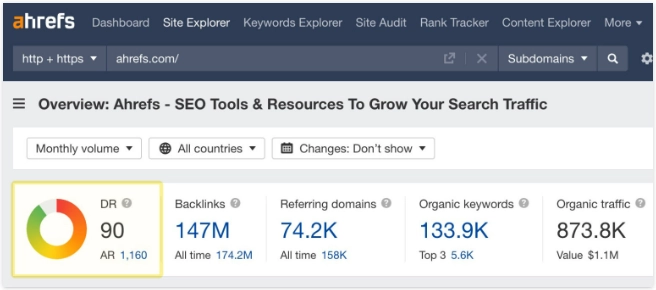 DR is measured on a logarithmic scale of 0 to 100. The score estimates the potential authority your domain has with search engines like Google and Bing. Even though this metric is just an estimation based on your website data, it can be useful in determining how well your website could perform on search engine results pages (SERPs).
 How Do You Calculate Domain Rating?
According to Ahrefs, calculating DR is quite similar to calculating PageRank. The only difference is that PageRank is measured between pages, while DR is calculated between websites. Here’s how you should calculate the Ahrefs domain rating of a site:- Find all domains that have at least one followed link to the target domain.
- Check out how many other domains each linking domain links to.
- Pass some amount of “DR juice” from each linking domain to the target domain. You need to determine this amount by dividing the DR of the linking domain by the number of unique domains it links to.
- If a site is only linking to you via nofollow links, it won’t boost your domain rating.
- Only the first link from a domain will boost your domain rating. All subsequent links will have no further impact on your DR.
- If a site (that has previously linked to you) continues linking out to more new websites, the amount of “DR juice” it sends you will drop over time. As a result, your own DR may also drop.
- As the DR of a site that links to you increases, it will start sending more “DR juice” to your site. In that case, your own DR may also increase.
How to Check Your DR Score?
If you use the Ahrefs tool, you can get access to a free Website “Authority” Checker that helps you find the DR of your website. The term “Authority” is in quotations because even though the tool tracks domain ranking, most users consider this metric “domain authority.” You can simply copy and paste your website’s URL into the search box on the tool and click the button to receive your DR score. You must be aware that free programs usually have certain limitations. For example, it may limit how many searches you can do per day. If you want to access more features and unlimited checks, you may need to subscribe to the tool's premium services. While marketers prefer Ahrefs to check the DR score of their sites, other domain rating checker tools like SmallSEOTools, DupliChecker, etc., also help you check the score.The Importance of Domain Rating
There are two major reasons why website owners or SEO professionals need to know their site’s domain rating score. Firstly, it is a good practice to gather as much information as possible about your site’s performance online. Since data does not lie, you can look at the DR score as an unbiased reflection of your link-building efforts. Secondly, you can use domain ratings to set goals for your content marketing and SEO strategies. When you set a bar for your current performance, it becomes a lot easier to plan your next moves. You can also benchmark your website against competitors. If they have a higher DR score than yours, you should analyze their strategies and adjust your SEO efforts accordingly. Also, a higher DR usually results in more traffic to your website. When your site has a higher DR, it is most likely to rank for a wider range of keywords and has the potential to attract more organic traffic from search engines.Does Domain Rating Impact a Page's Google Ranking?
 While domain rating is often associated with a website’s search traffic, it is not recommended that you focus all your efforts on growing this metric in particular. As you may realize, search engines like Google rank pages and not websites. Thus, your efforts should be focused on creating valuable content and acquiring high-quality backlinks directly to that content. When your backlink strength improves, your DR and search traffic will grow automatically.
 How To Improve Your Website’s Domain Rating?
Even though your site’s domain rating score does not have a direct impact on its search engine rankings, it helps you gain better positioning in your industry or niche online. So, when you notice an improvement in your DR score, your SEO and ranking potential may also get better. Here are some of the effective ways you can increase your DR score and boost your chances of ranking better in search results.Improve Your Backlink Strategy
We have already mentioned that domain rating is a link-based metric. So, the most effective way to boost your DR score is to improve your backlinks, both in terms of quality and quantity. To achieve that goal, you need to develop a strong, white-hat strategy for content marketing and link building. Focus on increasing your dofollow links from reputable websites with high domain authority. You can make good connections and increase organic traffic to your website by engaging in content promotion, such as guest posting, sponsoring content, and performing thorough keyword research. These activities help you acquire more backlinks. Also, prioritize dofollow links over nofollow links when possible. Nofollow links do not help your DR score as much. If you come across any shady or spammy backlinks, disavow them to improve your backlink health.Acquire Backlinks from Different Websites
As discussed earlier, you get link credit toward your DR score only for the first dofollow backlink from an outside source. This is why getting multiple inbound links from the same set of websites does not add value to your domain rating. In this scenario, referring domains matter more than almost any other linking factor. The more diverse your backlinks are, the better your DR score is likely to be. You will need a bunch of backlinks for success, but you need them to come from different referring domains. You must prioritize dofollow links because they give you more “link juice.” However, the number of referring domains period, both nofollow and dofollow, has a massive impact on the DR score. One of the most important facts about the DR score is that the quality of the link is not as important as it is with other metrics. Here, bad backlinks (low-quality backlinks or spam) can actually improve your DR score. But that does not mean you should start acquiring backlinks from random sources to amp up your score. This may hurt other aspects of your SEO.Focus on Your SEO Efforts
Even though domain rating is based on links, a site’s backlink profile does not exist in a vacuum. When your SEO is not up to the mark, the linking potential of your site also suffers. Apart from acquiring quality backlinks, you also need to focus on other SEO factors, such as internal linking, search intent, keyword usage, and user experience. You need to make sure that your site is optimized for mobile devices. You should also leverage social sharing buttons to make it easier for users to link to your content on their feeds. Do your homework to understand what your target audience is looking for on the internet. Once you know that, you can develop content to fulfill their needs and answer the questions they have.