
In the bustling world of digital marketing, SEO and PPC stand as pillars, each offering distinct advantages. But which one should you prioritize for your business? If you’re grappling with this question, you’re not alone. Join us as we delve into the intricacies of SEO and PPC, unraveling their true value and uncovering which strategy reigns supreme in 2024. Whether you’re a seasoned marketer or a budding entrepreneur, this comprehensive guide promises to equip you with the insights needed to make informed decisions.
The main difference between SEO and PPC is that SEO (Search Engine Optimization) is more of a long-term strategy. The value and results of SEO efforts manifest in the long-term, showing organic traffic growth after months of performing multiple optimization procedures. On the other hand, PPC (Pay-Per-Click) provides immediate visibility and results. By tactically paying for ads across search engines and social media platforms, it is possible to quickly gain a lot of attention. A combination of both SEO and PPC strategies can result in incredible outcomes, showing increased consistent growth.
SEO and PPC are two of the most effective marketing strategies that hold the potential to create results.
However, businesses looking to reach their target groups often juggle between these two, wondering what would be their best bet!
If you are a business owner or marketer struggling to decide or compare, this guide will make the job easier for you.
Here’s a detailed comparison of SEO and PPC that every marketer should read once! So, grab your notepad and pen, and let’s get started!
SEO and PPC: Do They Compare? Why Do They Compare?
The short answer is yes. There is a comparative difference between SEO and PPC.
While managing SEO, we optimize a website’s on-page and off-page factors to make it rank higher in the SERPs. From formulating a keyword strategy to resolving a website’s technical issues and coming up with a robust link-building strategy—SEO involves it all.
On the other hand, PPC marketing is when we strategically place ads across search engines, advertising partners, and social media platforms, paying the advertising platform to display our ads to users who may be interested in our product or service.
As a result, PPC is popularly known for creating results at a quicker pace when compared to SEO.
However, does everyone need to prioritize SEO or PPC?
The comparison between these two arises due to the time and budget constraints of a business. When a business is looking for instant results, its first preference is PPC. However, as their approach turns to organic marketing, SEO usually tops their priorities.
To clear out the confusion, it’s best to get into the details of SEO and PPC and the type of results they can create under different circumstances. So, let’s start with SEO.
SEO’s Stand in the Comparison!
Now that we are here to compare let’s see the value SEO can bring to your business.
1. Generate Awareness and Leads with SEO
Awareness usually starts with audience attention, then turns into interest and consideration, and eventually increases brand recognition.
As you look forward to boosting brand awareness and generating leads for your business, SEO can be a key catalyst.
And how does that happen?
One of the key highlights of the SEO process is to target keywords that your buyers or prospective customers are searching the internet with. Usually, this targeting happens through pillar blogs that educate customers and encourage transactions.
For example, a sunglasses company named AXZ wants to build its customer base in the United States. Now, AXZ may know that all of its customers and prospects may not buy from its E-Commerce website, as many of them may want to touch, feel, and try the products before buying.
However, targeting relevant keywords for SEO will boost their brand visibility and incline more prospects towards their range of sunglasses, also encouraging them to buy these products from their store.
This is how SEO can boost brand awareness and improve lead generation—the higher the brand popularity, the better its chances of being sold.
2. The Compounding Effect of SEO
Every business would want compounding returns on their marketing efforts. However, businesses often tackle multiple variables to achieve this. Fortunately, a robust SEO strategy can create compounding results.
Picture a relentless snowball rolling down the mountainside, gaining momentum with each rotation. This is what the compounding effect of SEO offers.
The results of the compounding effect are yielded when the content you have developed over time ranks higher, continues generating website traffic and leads, and boosts revenue for many months in a row. At its core, the compounding effect of SEO revolves around one simple principle: The longer you invest in it, the greater the results it yields.
This keeps brand relevance high and helps marketers adopt smarter SEO strategies involving old content refreshes and thorough keyword optimization across the website.
Another way of achieving a compounding effect is to create content on evergreen topics. For example, if a business sells organic dog supplies, apart from creating commercial articles, they should also write educational pillar blogs around topics such as “best organic dog food recipes” or other evergreen keywords that can attract readers across the year.
3. Organic Traffic: The Perfect Investment for Business
While most social media trends come and go speedily, SEO keyword trends usually last longer. This makes SEO one of the perfect marketing investments a business can make.
For example, if your business is able to find rich SEO keywords with a growing or stable trend, creating quality content and implementing a smart link-building strategy can help you outrank your competitors and rule the SERPs for years to come.
Hence, we recommend that SEOs and marketers always include trend checking as a part of their keyword research process. And as you research keyword trends, Google Trends can make the job easier.

Another compelling benefit of organic traffic is the return on investment. While paid ads may deliver immediate results, their impact may wane the very moment you stop adding funds. Organic traffic through SEO multiplies your efforts, delivering sustainable growth and exponential returns on your investment.
How PPC Makes Lead Generation a Smooth Sail!
PPC works on a targeted approach, allowing businesses to show their ads to precisely the right audience at the right time. With Advanced targeting options ranging from demographics and interest categories to geo-targeting features, PPC campaigns cast a wide net, ensuring that every click leads to a potential customer. Whether you are targeting a domestic or global audience, PPC gives wings to your sail, making your product reach those who are most likely to convert.
Here’s what PPC is mostly sought after for:
1. Quick Results Give a Kickstart to Your Business
Whether you are new in business or launching a different product under the same business, you’ll surely enjoy some early results.
PPC is one tried-and-tested method for achieving objectives.
Unlike traditional advertising, where budgets are often overrun and outcomes are uncertain. PPC offers some flexibility and control over your advertisement.
With real-time analytics and performance tracking features, marketers can constantly track and optimize their advertising campaigns for maximum efficiency and ROI.
PPC allows businesses to chart out the entire customer journey, starting from the first click to the final conversion. By tracking important key metrics such as form fills, phone calls, and purchases, businesses can gain deep insights into which campaign is delivering better results and optimize their ad copies, campaigns, and ad sets accordingly.
2. How Businesses use PPC to Generate 2, 3, or 4X ROI
The core function of PPC is to act fast and generate quality results, whether awareness or leads.
Four core PPC verticals that businesses put efforts into:
Laser Focus Targeting
At the heart of any successful PPC campaign lies the art of precision targeting. By positioning the most relevant keywords, demographics, interests, etc., businesses can ensure that their ads reach the right audience and are most likely to convert.
Compelling Ad Copy & Design
With compelling ad copy and creative designs, businesses can capture the attention of their audience and compel them to take action. In this case, the core objective is to make use of the art and science of persuasion to drive clicks and conversions.
For example, Slack came up with this stunning ad and a simple ad copy featuring their 50% sale. The best part is that they used an engaging video and not a static post.

This video simply symbolizes the type of communication that Slack wants to put forward as a brand. (Loved the part where “lonely” turns into “lovely”).
Continuous Optimization and Testing
The key to perfecting a PPC campaign is not only limited to setting and letting it perform but also to continuous testing and optimizing. By monitoring performance metrics, analyzing data, iterating on ad creatives, and targeting ad parameters, businesses can level up their campaigns for maximum efficiency and effectiveness.
Continuous optimization is an ongoing journey and it primarily involves error finding and analysis.
For example, when promoting an event in California, a marketer may target both men and women between the ages of 18 and 34. However, after the first ad run, based on the responses, they may be required to make certain changes to the targeting.

For example, in the screenshot above, the ad performed better for men between 18 and 24 and didn’t receive enough clicks from women. Hence, depending on other factors, we can consider creating a different ad for women and targeting only men with this ad.
Conversion tracking
With popular conversion tracking tools such as Google Analytics and Unbounce, businesses can gain valuable insights into which campaigns, keywords, and channels are driving the highest number of conversions for their business.
Based on this data, marketers can optimize these campaigns or create new optimized campaigns. This approach helps marketers smartly allocate PPC funds and create better results.
3. Mistakes to Avoid in PPC Marketing
In PPC campaigns, every click carries a weight of potential success or failure with money at stake. So, it becomes crucial to identify and avoid mistakes that can cost your business $$$$.
Here are the common and uncommon mistakes that marketers must beware of:
Half-Measures in Keyword Research
Be it for SEO or PPC marketing, keyword research largely determines how a campaign is going to perform.
Oftentimes, while researching keywords, marketers can come across terms and phrases that may seem to make complete sense for the brand, their bid prices may be suitable, intent may seem fine, and they may have a good amount of search volume—under general circumstances, anyone can think it’s a great keyword.
However, oftentimes, there’s more to keyword research.
As we look for relevant keywords, we must ensure that the keyword does not include a negative term such as “Cheap,” “Free,” or “Repair.”
By using such terms, marketers may somehow be able to boost CTR, but the cost per conversion may decline as the audience coming from these keywords may not actually be surfing with a transactional intent.
Ignoring Ad Copy Optimization
Your Ad copy is the front runner and voice for your product. It shows up and speaks to your audience amid the cacophony of digital noise. Businesses should ensure to optimize their ad copies for maximum impact and response.
Just like Harry’s Shaving company did with their “ripper” of an ad copy.

Missing out on Landing Page Optimization
Your ad campaign may lead potential customers to your website, but if your landing page is cluttered and uninviting, they are unlikely to stick around.
For these reasons, it’s advisable to have a CRO (conversion rate optimization) expert on board. An expert can help you declutter your landing page and optimize every element to boost conversions.
To do this, the CRO expert may also use a Hotjar Heatmap as follows:
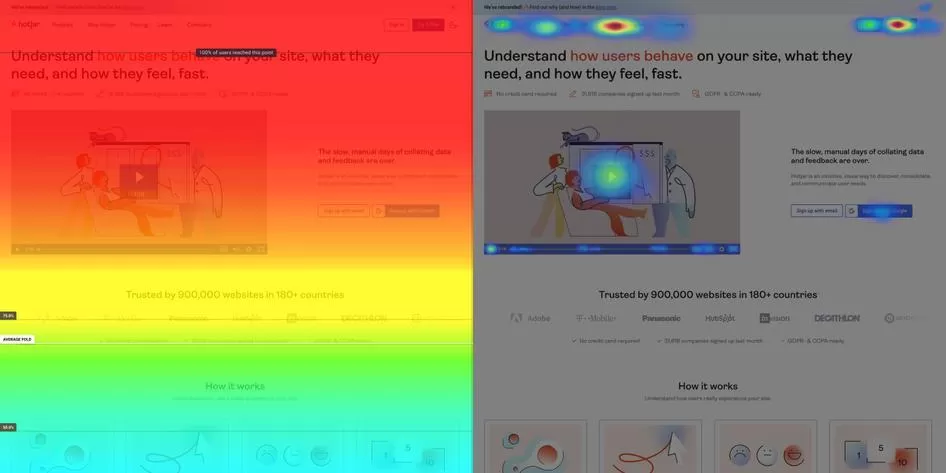
A Hotjar Heatmap enlightens marketing professionals with insight into which part of their landing pages their users are interacting with the most.
Based on this information, CRO professionals can come up with a landing page design that performs better.
Joining Hands: How Can Pro Marketers Use SEO and PPC For a Profitable 2024?
Like two ships sailing in tandem, SEO and PPC can be viewed as complementary strategies, with each having its unique strengths.
In 2024, professional marketers should forge an alliance combining the strengths of SEO and PPC.
Here are some tips that can help:
Establish a Unified Strategy
Harness the power of SEO and PPC to achieve business goals and consider them as complementary components of broader marketing strategy. Identify common objectives, target audiences, and messaging themes that could be leveraged for both SEO and PPC.
Maximizing Visibility and Reach
The operating principles of SEO and PPC could be different, but they share a common goal, which is to increase the visibility and reach of your brand and eventually improve sales.
Craft your strategies in a way that your SEO content can also be leveraged for turning PPC prospects into customers and brand advocates.
Enhancing Keyword Research and Optimization
Keyword research is invaluable for both SEO and PPC, providing insights into the language and buying intent of your target audience. By combining both these forces, marketers can leverage the wealth of data that can be collected from both channels.
This can further make your optimization efforts more fruitful.
Leverage Cross-channel Insights
Use data from PPC campaigns to identify high-converting keywords, audience interest, and their buying intent, and further apply them to level up your SEO and content strategy.
Likewise, use SEO strategy to identify top-performing content pieces and use them appropriately in your PPC funnel.
Final Words: What’s Better, SEO or PPC?
As we conclude this blog, let’s settle this ever-growing debate all for once
The best marketing channel is the one that creates great marketing results in your industry and for your business. However, to grow your business at the right pace, it’s advisable to use a mix of the most profitable marketing strategies, which definitely include both SEO and PPC.
Through this article, we highlighted various overlaps and differences between SEO and PPC and put them through an actionable comparison. We hope this discussion helps you optimize your marketing campaigns, allowing you to make the most out of your marketing efforts.