
Discover the average bounce rate in different industries for 2025, and the reason behind the numbers. Moreover, finds tips on how you can improve it and enhance your overall online performance.
In the digital world, bounce rate is a key indicator of how visitors perceive your website. Think of it as a report card; it reflects how well your site captures and holds your audience’s attention.
Understanding bounce rates across different industries is essential, as they offer insights into user engagement, website performance, and areas needing improvement. In this blog, we’ll break down what bounce rate means and how it varies by industry, so you can better assess how your site stacks up and where to focus your efforts.
What Is Bounce Rate?
Bounce rate is a digital marketing metric that determines how many people have visited a webpage on your website and left without going through any other pages. It is calculated by dividing the total number of visitors who have visited one page by the total number of visitors on your site.
A high bounce rate may indicate that users aren’t finding what they expected or that your page isn’t engaging enough. To improve this, focus on relevant content, clear calls-to-action, faster load times, and user-friendly design. Lowering bounce rates can boost conversions and enhance your site’s overall performance.

Note: You need to remember that bounce rate is not the same as exit rate. Exit rate is the number of visitors who leave your website from a specific page. It tells you how often a visitor exits from a page. Since bounce and exit rates are almost the same, it is essential not to get confused, as both have different relevance in digital marketing.
Why Bounce Rate Matters for Your Business
Bounce rate matters for your business because it displays user behavior. It shows that the visitor entered your website and left it immediately, indicating a serious problem with your webpage. It also shows that visitors came to your website with a certain expectation, but since they didn’t find what they were looking for, they left the page immediately.
Let’s now address the big question: Is a high bounce rate concerning for a business? Well, not really. It depends on the page’s purpose. For instance, if the page has a recipe or an article, it is normal to have a high bounce rate. It means the user visited the page, found what they were looking for, and left.
However, an average bounce rate may be concerning if you have a multi-page site like an e-commerce website. In this case, the visitor didn’t want to browse your products further. This may be because your website is challenging to navigate or your content is irrelevant to search queries.
So, a high average bounce rate doesn’t mean the same thing for everyone. It is just a compass that gives website owners direction on the steps they should take to improve their website and shouldn’t be taken as a road map.
A high bounce rate is never desirable. However, you need to understand that the key to lower bounce rates is understanding the user’s search intent. Another thing to consider is that the goal is not just to give users what they are searching for; it is to provide them with the answers so that your content doesn’t feel like the same recycled answers they will find on any other website.
Key Indicators of a Good Bounce Rate
So, what is a reasonable bounce rate? A reasonable bounce rate is different for different websites. Finding consensus on what a good bounce rate is is like finding the best pizza topping. Different people have different opinions, depending on the individual’s taste and context. A good bounce rate is not a one-size-fits-all thing; it varies from website to website and according to the goals.
The ideal bounce rate ranges from website to website and depends on a particular page’s purpose. However, it is always best to aim for a lower bounce rate for the obvious reasons. Realistically, a website’s average bounce rate will be around 50%. It is impossible for your website to answer every visitor’s search queries, plus, as mentioned earlier, the purpose of different websites is different.
Although a website’s overall bounce rate is important, it is also crucial that website owners take some time to look at the bounce rate metrics of individual sites. This will give them a better idea of the problems that a particular page may be facing.
Average Bounce Rate by Industry: 2025 Data
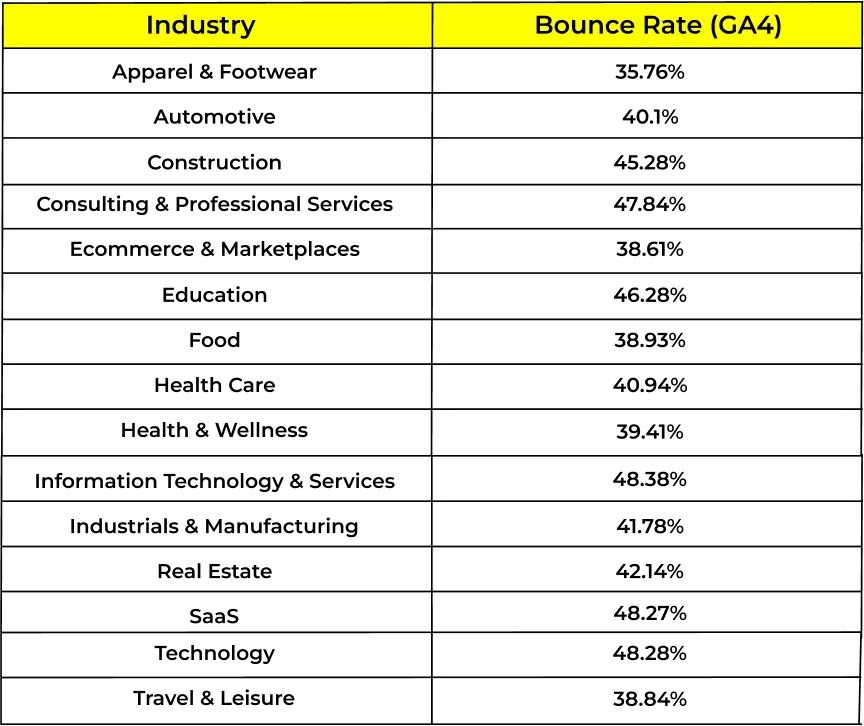
The data mentioned above (source: Databox) is based on a recent study. It showcases that the median bounce rate for all industries is 44.04%. One thing that has been noticed in the studies is that the footwear and apparel industry has the lowest bounce rate at 35.76%. This may be due to the very nature of the industry. People who browse these websites clearly intend to purchase, which leads to a low bounce rate.
An e-commerce site generally has a lower bounce rate, as seen in the table above. This trend is because visitors are most likely to browse through a couple of products from the same niche before they purchase, which leads to a lower bounce rate. In contrast, blogs and news websites often see higher bounce rates since users typically visit for a specific article and leave once they’ve read it. This doesn’t necessarily signal poor performance.
Top Industries with High Bounce Rates
Blogs / News / Media Sites
A study has shown that content-driven websites such as blogs, news, or media sites have a bounce rate of around 65% to 90%. These websites have the highest bounce rate among all the others. So does that mean the website fails to deliver the search intent? The answer is not always a yes.
Most web pages, including blogs, news, and media sites, satisfy the user’s search intent. Hence, the user doesn’t need to go through different pages to find their answer. This might be one of the reasons why these pages have a higher bounce rate. For example, a visitor discovers an interesting article piece on Facebook and clicks on it to read. Once they have read the piece, their purpose is fulfilled. So, they leave the site. The search intent is fulfilled, and no other engagement is involved. Although this leads to a relatively high bounce rate, it doesn’t mean something is wrong with the web page.
Travel / Tourism
According to another study, the travel industry recorded the highest average bounce rate in March 2023, 82.58%. There are numerous reasons for such a high bounce rate. One is that visitors may find the information they seek on the page. Hence, there is no need to explore any other pages on the website. Most often, visitors come to a travel website for travel-related information. So, once the purpose is fulfilled, there is no need to stay on the website any longer.
Another reason might be that a single website may not have all the information they seek. So, they browse different websites to find all the information they need. Moreover, they may also visit multiple websites to compare prices, accommodation, and other offers.
Food
The food and beverage industry has a high bounce rate of about 62.5%. Now the question is, why? Well, the answer is simple. For instance, a user found a post online that links to a healthy cake recipe. The user clicks on the URL, checks the recipe, and exits. In this case, the purpose of the web page is fulfilled. Take another example: the user wants to visit a restaurant, but they want to check the menu beforehand. In this case, they can directly see the menu page, check it, and exit, leading to a higher average bounce rate.
Entertainment & Events
The entertainment and event industry has a bounce rate between 30% and 50%. This is because content related to entertainment and events is mostly informative. So once they have entered a particular web page and enquired about the event, they tend to leave it without browsing further. Moreover, visitors browsing entertaining content, such as a blog or video, tend to view the content piece and leave without further engaging with the website. This leads to a high bounce rate.
Real Estate
The real estate industry’s bounce rate ranges between 30% and 50%. However, the bounce rate is not the same for all real estate website pages. It varies depending on the page the user lands on. In general, the home pages have a lower bounce rate of around 35%, because visitors want to interact further. Property listings have an average of 42%, the property details page has a bounce rate of 55%, the contact us page has 51%, and the service page has 41%.
The home page has a relatively lower bounce rate because visitors generally navigate their way through the other pages on the site for more detailed information about the properties listed on the site.
Top Industries with the Lowest Bounce Rates

Apparel & Footwear
A study found that the footwear and apparel industry has a very low bounce rate of around 27.92%. This is because most people who visit these websites have a clear intent of making a purchase. Moreover, people don’t stop at just one page when looking for apparel or footwear online. They tend to go through multiple pages on the sites before they find the perfect shoe that they want to purchase. Studies have shown that online fashion websites also experience a low bounce rate of 38.3%. This is because users want to go through different pages and view details about the sizing and quality of an outfit before making a purchase.
Ecommerce & Marketplaces
High-performing e-commerce sites have a very low bounce rate. According to Plausible Analytics, the bounce rate on an e-commerce site is between 20% and 55%. The lower bounce rate is because most visitors like to explore different options and check details of various products before spending money.
Now, one thing you need to remember is that a low bounce rate doesn’t always translate into a high conversion rate. However, even if the visitors don’t actually make a purchase, the low bounce rate signifies that your products were able to grab the right attention.
Health and Wellness
The health and wellness sector has the lowest bounce rate, about 39.41%. This means people don’t stop at one webpage and go through more pages before exiting. The idea is simple: when it comes to health-related content, people want to research further before they make any purchase.
For instance, a new health supplement promises great anti-aging benefits. When visitors come across such a product, they are most likely to go through the other website pages, look for reviews, and other details to determine the brand’s credibility. This leads to a lower bounce rate for the website.
Factors Influencing Bounce Rate Variations
The truth is that there is no desirable bounce rate, and honestly, this metric can’t be taken independently. Now, there are different reasons why a website may be experiencing a high bounce rate, and seldom is it due to a serious problem present in the website.
Sometimes, a high bounce rate simply means users found the information they needed quickly. Other times, it could be due to misleading titles, poor design, or irrelevant traffic sources. In the section below, we have given a few reasons why your website may be experiencing a high bounce rate:
User Intent
If your page ranks for the wrong keywords, you may be experiencing a high bounce rate. The keywords depict the user’s search intent. So, if the content of your website and the keywords don’t match, you are likely to experience a high bounce rate. Remember that simply ranking for keywords is not enough; relevant content is the key to online success.
To solve this problem, you can use Google Console. The tool will show which queries are driving unqualified traffic to your website. Based on this information, you can optimize your content for the search terms, enabling you to bring qualified traffic.
Website Design and Usability
User experience is another factor that determines your website’s bounce rate. No one wants to be bombarded with pop-up ads, email subscription buttons, or forms right after they enter your site. Although this tactic may be quite luring, the results are not always positive and mostly lead to a high bounce rate.
For online success, providing visitors with a good user experience is vital. Hence, you must determine whether your website is easy or difficult to navigate. Can they find all the information they are looking for instantly? Are the CTAs difficult to click on a smartphone? Most importantly, is the website compatible with various devices?
Most website owners forget about intuitive navigation and compatibility with different devices when designing their sites. But remember that it is one of the most essential aspects determining a website’s bounce rate.
Content Relevance and Quality
The truth is your content speaks louder than any other expensive marketing strategy. So, it is important to ensure that it is relevant to the search queries and that users can find what they are looking for in one place. This will encourage them to explore the website more, which in turn will reduce the bounce rate.
Visitors exit your site because your content quality doesn’t meet their expectations. So, how do you improve it? You need to ensure the sentences are simple and easy to understand. Moreover, it should be able to answer their questions. Another thing that most owners forget is that it should be easily scannable, ensuring that readers know what they are getting into even before reading the content piece.
Traffic Sources
Different traffic sources have different bounce rates. For instance, email and referral traffic have the lowest bounce rate because the audience is highly targeted and is interested in your content. On the other hand, display ads have a higher bounce rate because the users you reach via different ads may not be genuinely interested in buying our products. Moreover, some might be researching your content and have not made a purchase decision.
Strategies to Reduce Bounce Rates
A low bounce rate is always important, but desirable. Hence, every website needs to aim for it. You need to give your visitors a good user experience to achieve it. Let us find out how:
Enhance Page Load Speed
Many marketers assume that a high bounce rate is due to the content on the website. However, they forget to address one serious reason visitors exit immediately: a slow loading time. 47% of users want a web page to load within two seconds or less. This helps reduce bounce rates and enhances the overall user experience. If your page is taking ages to load, your visitors won’t be able to read the content in the first place. So, you need to make sure that your page loads quickly.
Improve Content Quality
Simply uploading a wall of text on your website, no matter how informative, is not enough. Yes, informative content is important, but so is the structure. Hence, you need to format your content to make it welcoming and accessible to your visitors. Visitors are more likely to stick around when they find what they are looking for.
Make your content visually appealing and approachable so it doesn’t overwhelm visitors. To do this, you need to check whether your content has appropriate headers, subheadings, suitable images, and bullet points, ensuring it is not intimidating for the readers.
Optimize for Mobile Devices
What are you even doing if you haven’t optimized your website for mobile devices? Mobile optimization is essential in 2025. A majority of your visitors are probably accessing your website through their mobile devices. Hence, mobile optimization is vital for decreasing bounce rates. 73.1% of website designers think that one of the significant reasons why visitors leave a site is that it is not optimized for mobile phones.
Clear Calls-to-Action (CTAs)
CTA or call to action guides visitors through the site, enabling them to take desirable action. But if your CTAs are unclear, your visitors won’t understand the actions they need to take upon visiting the website.
When adding CTAs, make sure they are clear and direct, such as “Shop Now,” “Sign Up,” or “Learn More.” Moreover, the CTAs should stand out so your visitors know where to go. Giving your visitors clear directions will reduce the bounce rate and enhance the overall engagement rate.
Internal Linking
Appropriate internal linking keeps users engaged and encourages them to explore more content. You can significantly reduce your website’s bounce rate by providing your visitors with links to other content pieces that they will most likely be interested in. Internal linking does wonders for your website. Adding these links is like a torchlight, helping users see what is ahead. With internal linking, visitors won’t realize that more content may interest them, reducing bounce rates.
Conclusion
Analyzing your website’s bounce rate will help you understand its overall health. It will also enable you to identify areas where you may be lagging behind, so that you can engage your users further. Now, one thing that you need to remember is that the bounce rate should never be viewed independently because this metric will not help you understand everything in totality. Instead, bounce rate should be analysed alongside other metrics like session duration, pages per session, and conversion rate. You must look at other metrics, such as page loading time, conversion rate, engagement rate, and mobile optimization, to understand why the bounce rate is high.
Together, these offer a more complete picture of user behaviour and website performance, helping you make informed decisions about content, design, and functionality to improve engagement and achieve your business goals.